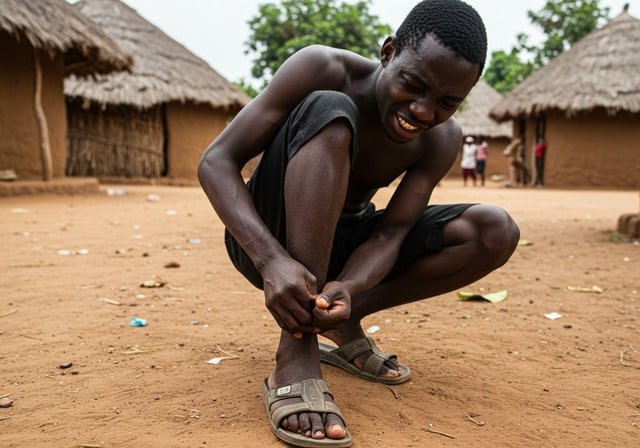


Your mother stops coming to Sunday lunch. She says her feet are tired. Six weeks later there is a wound on her heel that nobody in the house has seen, because she cannot bend far enough to look and nobody thought to check.
That sequence is popular in Nigerian homes and this is how most amputation cases begin. Foot care for the elderly in Nigeria fails at the noticing stage far more often than at the treatment stage.
This guide covers what to look for, what to do at home, when to get clinical help, and which common Nigerian remedies make things worse. It is written for the adult child or caregiver who is doing the looking.
Key takeaways
- Older people make up about 30% of the patients seen at Flawless Esthetics Clinic, most arriving for something small like an ingrown nail while a wound they cannot feel goes unnoticed.
- Foot care for the elderly in Nigeria needs clinical assessment, not a salon pedicure, because thickened nails and numb feet carry risks a beauty technician is not trained to spot.
- At the University of Abuja Teaching Hospital, a structured foot care education programme cut the amputation rate among diabetes patients from 50% in 2009 to 10% by 2017.
- Across 18 Nigerian studies covering 2,616 patients, one in three people admitted with a diabetic foot ulcer lost part of a limb.
- Nigerian patients wait a median of 39 days after an ulcer appears before reaching hospital, and 92% try home remedies, herbal treatment or a chemist first.
- A daily two minute foot check at home catches almost everything early, and it costs nothing.
When to go to hospital today
Do not wait for an appointment if you see any of these on an older person’s foot.
- A wound that has not closed in two weeks
- Any black or grey skin on a toe, heel or foot
- A wound that smells
- Redness spreading up the foot or ankle
- Fever alongside any foot wound
- Sudden swelling in one foot when the other is normal
Any one of these needs a hospital the same day. Do not wash it with hot water first. Do not apply anything to it. Go.
What is foot care for the elderly?
Foot care for the elderly is the routine inspection, skin and nail maintenance, and clinical treatment of age related foot problems, carried out to keep an older person walking and to stop small injuries becoming serious infections.
It covers daily checking at home, professional nail and callus work that household tools cannot do safely, and early treatment of wounds and infection.
Why foot care for the elderly in Nigeria matters now
Nigeria has the highest number of older people of any country in Africa, and the population aged 65 and above is projected to nearly triple by 2050 (Aging in Nigeria, 2022). Most families here will care for an older parent at home, and very few have been told what to watch for.
Diabetes makes an ordinary foot problem dangerous
Nigeria has the largest number of adults living with diabetes in the IDF Africa region (IDF Diabetes Atlas). Diabetes damages the nerves in the feet, which means a person can stand on a nail, develop a blister or split a heel and feel nothing at all.
The consequences in Nigerian hospitals are severe. A review of 18 studies covering 2,616 Nigerian patients between 2005 and 2024 found that one in three people admitted with a diabetic foot ulcer went on to have an amputation, and close to one in five died (Journal of Epidemiology and Global Health, 2025).
The problem is late arrival, not bad medicine
Nigerian patients reach hospital a median of 39 days after their ulcer first appears. Only a quarter of them had ever received any foot care advice before that admission (MEDFUN multicentre study).
Those two numbers explain the amputation rate better than anything else. By the time a wound is bad enough to frighten a family, the infection has usually reached bone.
Education changes the outcome
This is the most encouraging finding in Nigerian literature. When the University of Abuja Teaching Hospital ran a structured foot care education programme for its diabetes patients, the amputation rate fell from 50% in 2009 to 10% by 2017 (Impact of diabetes foot care education, 2020). Patients were simply taught what to look for and when to come in. That was the whole intervention, and it saved limbs.
The daily foot check
Two minutes, once a day, preferably in the evening. Do it yourself if the person cannot reach or cannot see well.
- Sit them down with good light. Not a phone torch in a dark room.
- Look at the top of each foot, then the sole, then the heel.
- Separate every toe and look between them. Fungal infection starts here and it is easy to miss.
- Use a mirror on the floor for the underside of the heel if bending is difficult.
- Press gently along the sole and ask whether they feel it. Compare left with right.
- Feel both feet with the back of your hand. One foot noticeably warmer than the other is a warning sign.
- Check inside their shoes with your hand before they put them on. Stones, torn lining and insects cause wounds nobody feels.
Write down anything new and date it. If a mark has not gone in a week, book an appointment. If it matches anything in the red flag list above, go to hospital.
Four areas of clinical care
Nail and callus work
Thickened nails, corns and hard calluses need a trained hand and sterile instruments. Salon pedicures are a poor fit for older feet because technicians work fast, share tools, and use blades that create micro tears in skin that no longer heals quickly.
Clinical nail reduction thins the nail without cutting the skin underneath, which matters enormously for anyone who cannot feel a cut.
Skin and heel fissures
Older skin produces less oil, and the Harmattan strips what remains. Deep heel cracks are not a cosmetic problem. They are open doors, and bacteria walk through them.
High concentration urea creams are used clinically to soften thickened skin and close fissures. DermaFIX-Cream was formulated for this climate. Apply it twice daily to clean, slightly damp skin, and do not forget to also cream the spaces between the toes.
Diabetic foot protection
Anyone with diabetes needs sensation testing, circulation checks and a clear risk grade. Where sensation is reduced, the daily check stops being optional and pressure relieving insoles become worth their cost. This is preventive work. Once a diabetic wound or ulcer has formed, it needs a hospital or a diabetic foot specialist, so the goal is to catch the risk long before it reaches that point.
Footwear
Most falls and most pressure wounds trace back to the shoe. Look for a wide front, a closure that adjusts, a cushioned insole, and a sole that grips on wet tile. Rule out backless slippers indoors, which are the single most common cause of falls in Nigerian homes.
What we see at the clinic
About 30% of the patients seen at Flawless Esthetics are older people, and most arrive for something small like an ingrown toenail or hard skin rather than for the diabetes underneath it. The diabetes, and often a wound the patient cannot feel, is found during the examination.
That is the pattern behind the numbers. Because of neuropathy, an older person may not feel a wound at all, and many cannot bend far enough to see or reach their own feet. The problem sits unnoticed until someone examines the foot properly.
The clinic’s role here is prevention, not wound treatment. Flawless Esthetics does not treat or manage diabetic wounds. The work is to catch a problem early, before it becomes an ulcer, and to send the patient to the right doctor quickly when it needs clinical treatment.
For elderly patients, we become their eyes. Many cannot feel a wound because of neuropathy, and they cannot bend to check their own feet, so they come to us not knowing anything is wrong. We do a foot examination, and often we find a wound they were not aware of. We do not treat diabetic wounds ourselves. What we do is prevention. We catch it early and act as a link between the patient and their doctor or endocrinologist, so it is managed before it becomes serious. We are not taking anyone away from their doctor. We are the ones who notice quickly that something is out of place.
Christiana Dogo, Director, Flawless Esthetics Clinic
Monthly or quarterly evaluations track the status of the feet over time, including circulatory problems the patient cannot detect. This is where the clinic earns its keep, because the national picture shows how costly late arrival is. Nigerian patients wait a median of 39 days with an ulcer before reaching hospital, and only a quarter have ever been given foot care advice.
Common mistakes in Nigerian homes
Treating foot pain as normal ageing. Pain is information. Arthritis, circulation problems and neuropathy all announce themselves this way, and all three are manageable when caught early.
Street nail cutters. Razor blades and clippers passed between customers cause ingrown nails, infection and tetanus. For anyone with diabetes or poor circulation, one cut is a serious event.
Hot salt or Dettol soaks. A person with numb feet cannot judge water temperature and will not feel a burn until the skin has gone. Harsh antiseptics also strip the remaining skin oils, which produces more cracks than it prevents.
Reaching for agbo or palm oil first. In the Abuja study, 92% of patients said home remedies, herbal treatment or a chemist would be their first response to a foot ulcer. That preference is the reason so many arrive at hospital a month too late. Traditional remedies do not clear infection from an open wound.
Cutting nails round or digging into the corners. Cut straight across, level with the end of the toe. Rounded corners are how ingrown nails start.
If you cannot reach a clinic
Nigeria has very few podiatrists, and most are in Lagos and Abuja. If regular clinic visits are not realistic, three things still work.
Do the daily check without fail, because it is the part that catches problems early and it needs no clinic. Ask your nearest general practitioner or nurse to test sensation and check pulses in both feet at any routine visit. And treat the red flag list as non negotiable, because a general hospital can manage an early infection that a specialist cannot save later.
Conclusion
Almost everything that costs a Nigerian family a limb starts as something small that nobody looked at. Teaching families what to look for is the intervention that changed the numbers in Abuja, and it is free.
Start the daily check tonight. If you find something that has not moved in a week, or anything on the red flag list, act on it.
For a preventive foot assessment, book a senior foot appointment at Flawless Esthetics Clinic. The clinic checks the feet, catches problems early, and refers on to a doctor or specialist if treatment is needed. Bring the shoes they wear most days and a list of their current medications. You can also see our full range of foot and nail services or contact the clinic if you are unsure whether a visit is needed.
Frequently asked questions
How often should an older Nigerian see a foot specialist?
Every four to six weeks for anyone with diabetes, thickened nails or reduced sensation. Once or twice a year is reasonable for an older person with healthy feet and no diabetes.
Can numbness from diabetes be reversed?
Usually not. Nerve damage tends to be permanent. Good blood sugar control and consistent foot care stop it worsening and sharply reduce the chance of ulceration, which is where the real risk sits.
Is it safe for my mother to cut her own toenails?
Not if she has diabetes, poor eyesight, limited reach or thickened nails. One slip creates a wound she may not feel and that may not heal. Somebody else should do it, or a clinic should.
Why do my father’s toenails keep going thick and yellow?
Most often a fungal infection combined with years of pressure from footwear. It rarely clears with over the counter treatment alone once the nail is thick, because nothing penetrates. Professional reduction plus antifungal treatment is the usual route.
Sources
- Aging in Nigeria: a growing population of older adults requires the implementation of national aging policies, 2022.
- IDF Diabetes Atlas, Nigeria country data.
- Epidemiology and outcome of diabetic foot ulcers in Nigeria: a systematic review and meta-analysis, 2005 to 2024, Journal of Epidemiology and Global Health.
- Burden of diabetic foot ulcer in Nigeria: evidence from the MEDFUN multicentre study.
- Impact of diabetes foot care education on amputation rate, University of Abuja Teaching Hospital, 2020.